
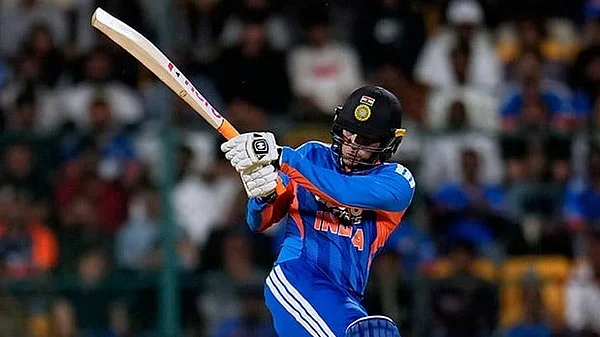
Abhishek Sharma: The Unstoppable Beast Who Made 199 Look Like a Small T20 Target
By Subham Sarkar | 27 October 2026 | India vs New Zealand, 3rd T20I, Wellington
A target of 199 used to demand a near-perfect T20 chase. In Wellington on Tuesday, India reached it with 40 balls still unused. At the centre of the chaos was Abhishek Sharma, whose 113 from 38 balls was less an innings of calculated acceleration and more a refusal to let New Zealand settle into the match.

What records did Abhishek Sharma and India break today?
The biggest verified record belonged to India's opening pair: 118 without loss in the first six overs, the highest Powerplay total in men's T20 internationals. Abhishek and 15-year-old Vaibhav Sooryavanshi put on 133 for the first wicket in just 7.1 overs. Abhishek also reached 11 centuries in all T20 cricket, moving past Virat Kohli's tally of 10. His 35-ball hundred was the fastest T20I century against New Zealand, but it did not beat his own 30-ball century against Afghanistan in September 2026.
| Milestone | What happened in Wellington |
|---|---|
| Abhishek's innings | 113 off 38 balls, 9 fours, 11 sixes; strike rate 297.37 |
| Century | Reached 100 in 35 balls |
| India's Powerplay | 118/0 in six overs — men's T20I record |
| Opening partnership | 133 runs in 7.1 overs with Vaibhav Sooryavanshi |
| India's chase | 199/4 in 13.2 overs, winning by six wickets with 40 balls left |
| Series position | India took an unassailable 3–0 lead in the five-match series |
These are not all individual world records. The Powerplay mark belongs to the team, the opening stand is a partnership achievement, and the 35-ball century is not the overall fastest in men's T20Is. That distinction matters when an innings is this spectacular: it needs no inflated claims.
How the match unfolded: from a strong 198 to a helpless defence
New Zealand's 198/3 was no ordinary total. Daryl Mitchell's unbeaten 89 provided the backbone, while Finn Allen and Bevon Jacobs kept the scoreboard moving. On most evenings, nearly ten runs an over would be a demanding chase. India instead treated it as an opportunity to attack from ball one.
The first over from Jacob Duffy cost 26. India were 64/0 after three overs and 118/0 after six. Sooryavanshi contributed a remarkable 45 from 19 deliveries, but Abhishek was the innings' defining force. He reached fifty in 15 balls and three figures in 35. India eventually finished on 199/4 after only 13.2 overs.
Why Abhishek's approach is so difficult to bowl to
What stands out to me is the lack of a comfortable escape route for the bowler. Abhishek is a left-hander who looks to score early, punishes width, and is willing to hit over the infield rather than simply collect singles until the final overs. The moment a bowler changes length to protect one boundary, a different scoring option can open.
There is an important difference between swinging at everything and attacking with a plan. Modern aggressive openers try to identify the ball they can hit hard, stay committed to that option and force field changes. Abhishek's innings was an extreme example of that philosophy. His nine fours and 11 sixes brought 102 of his 113 runs in boundaries alone — approximately 90% of his total.
Did he score only on the off side? Understanding his range
It would be misleading to claim an exact off-side-versus-leg-side split without an authenticated wagon wheel. The diagram below marks shot directions specifically mentioned in match commentary (cover-point, cover, point and mid-wicket). It is not a complete measured wagon wheel; no authenticated coordinate-by-coordinate tracking dataset was available.
The off-side strokes and final mid-wicket dismissal are described in ball-by-ball commentary. Arrows illustrate named sectors only; they do not represent every delivery, exact landing points or run totals by sector.
A full range of strokes does not mean every shot is equally safe. A batter still has to read length, pace and field placement. The practical lesson for young players is to build a reliable base — balance, timing and bat control — before trying to copy the spectacular sixes.
How did Abhishek score his 113 runs?
The ball-by-ball scorecard records 11 sixes, nine fours, one two, nine singles, no threes and eight dot balls. Boundaries alone supplied 102 runs — 90.3% of his innings.
Bars compare runs, not number of shots. Eight dot balls and one dismissal are not run-scoring shots. Source: Cricbuzz player performance scorecard.
Five fastest men's T20I centuries worldwide
Ranked by balls taken to reach 100, including Associate Member nations. Three players are tied on 33 balls, so six innings appear in the chart.
Country denotes the national team represented, not birthplace. Source: published men's T20I fastest-hundreds records, checked 27 October 2026.
Fastest T20I centuries by Indian batters
These are the five fastest individual innings, so Abhishek appears more than once.
Historical rankings checked against published T20I records; Wellington innings added from today's match report. The values are balls to reach 100, not final innings length.
How India are changing the meaning of a 200-run T20 total
For years, 200 was a psychological benchmark in T20 cricket. Today it remains a strong total, but it is no longer a guarantee of control. India's approach puts immediate pressure on the bowling side: if the Powerplay goes at nearly 20 runs an over, a chase can be transformed before captains have time to use their middle-over plans.
This is bigger than one innings. Batters now train for scoring options throughout the innings, not just at the death. Deep batting line-ups encourage openers to accept more risk. Better boundary-hitting skills and tactical match-ups have made previously daunting run rates feel achievable. Still, pitches, ground dimensions, weather and quality bowling matter enormously. Not every 200 will be chased in 14 overs.
The changing calculation
| Target | Required rate at the start | What it means |
|---|---|---|
| 160 | 8.00 per over | Usually manageable with wickets in hand |
| 180 | 9.00 per over | Demands sustained intent |
| 200 | 10.00 per over | Still substantial, but aggressive Powerplays can reshape the chase |
| 220 | 11.00 per over | Requires high boundary frequency and limited quiet overs |
These are mathematical starting rates, not forecasts of victory. Wellington is a reminder that a target's difficulty depends as much on the opposition's batting tempo as on the number itself.
The bat behind the name: SS Abhishek Sharma Player Grade
Abhishek's performance naturally makes fans curious about the equipment associated with his name. Khelmart lists the SS Abhishek Sharma Player Grade English Willow Cricket Bat, a premium short-handle model. Its product listing describes selected Grade 1+ English willow, a semi-oval handle, a substantial profile with concave edges, a Sarawak cane handle and an Aqua Grip. The listed manufacturer is Sareen Sports Industries, Meerut.
The listing describes the bat as designed to the player's profile, but that is not independent verification that the retail bat is the exact match-used bat from Wellington. A player-grade bat is also not a shortcut to professional-level hitting. Pickup, weight distribution, sweet spot, preparation and the batter's technique are far more useful considerations than a famous name on the sticker.
For readers comparing options, browse Khelmart's SS cricket bat collection, which includes English-willow and Kashmir-willow models at different price levels. An aspiring club cricketer may be better served by a bat with comfortable pickup and the right weight than by buying the most expensive player-grade model.
What young batters should learn — and what they should not copy
There is a temptation to watch an innings like this and start trying to hit every delivery for six. That misses the real skill. A batter needs to recognize hittable lengths, maintain a stable head position, choose gaps and understand when a risky stroke is justified. Practise driving, cutting and pulling with control before increasing power. And if your bat feels too heavy to swing cleanly, a lighter, better-balanced option is often the smarter purchase.
What comes next for T20 cricket?
I don't think Wellington means bowlers are becoming irrelevant. It means teams must find new ways to defend. Changing pace without predictability, using the crease, bowling to genuinely protected boundaries and adapting quickly to a batter's scoring zones will matter even more. Captains may also need to reconsider how early they use their best bowlers.
India's current approach is fascinating because it changes the opponent's mindset. A team can post 198 and still feel under immediate threat. The more regularly batters like Abhishek and Sooryavanshi turn the first six overs into an all-out assault, the more the old idea of a universally 'safe' total will disappear.
But the next test is consistency. One innings can redefine expectations; repeating the approach across difficult pitches, quality attacks and knockout pressure is what defines a lasting change in cricket.
Sources and fact-checking
- Cricbuzz — 38-ball innings, boundary and singles breakdown, shot commentary
- Outlook India — century and Full Member comparison; photograph source
- Khelmart — SS cricket bat collection



Comment(s)
No comments yet
Be the first to share your thoughts about this article.
Leave a Comment
Your email address will not be displayed publicly.