
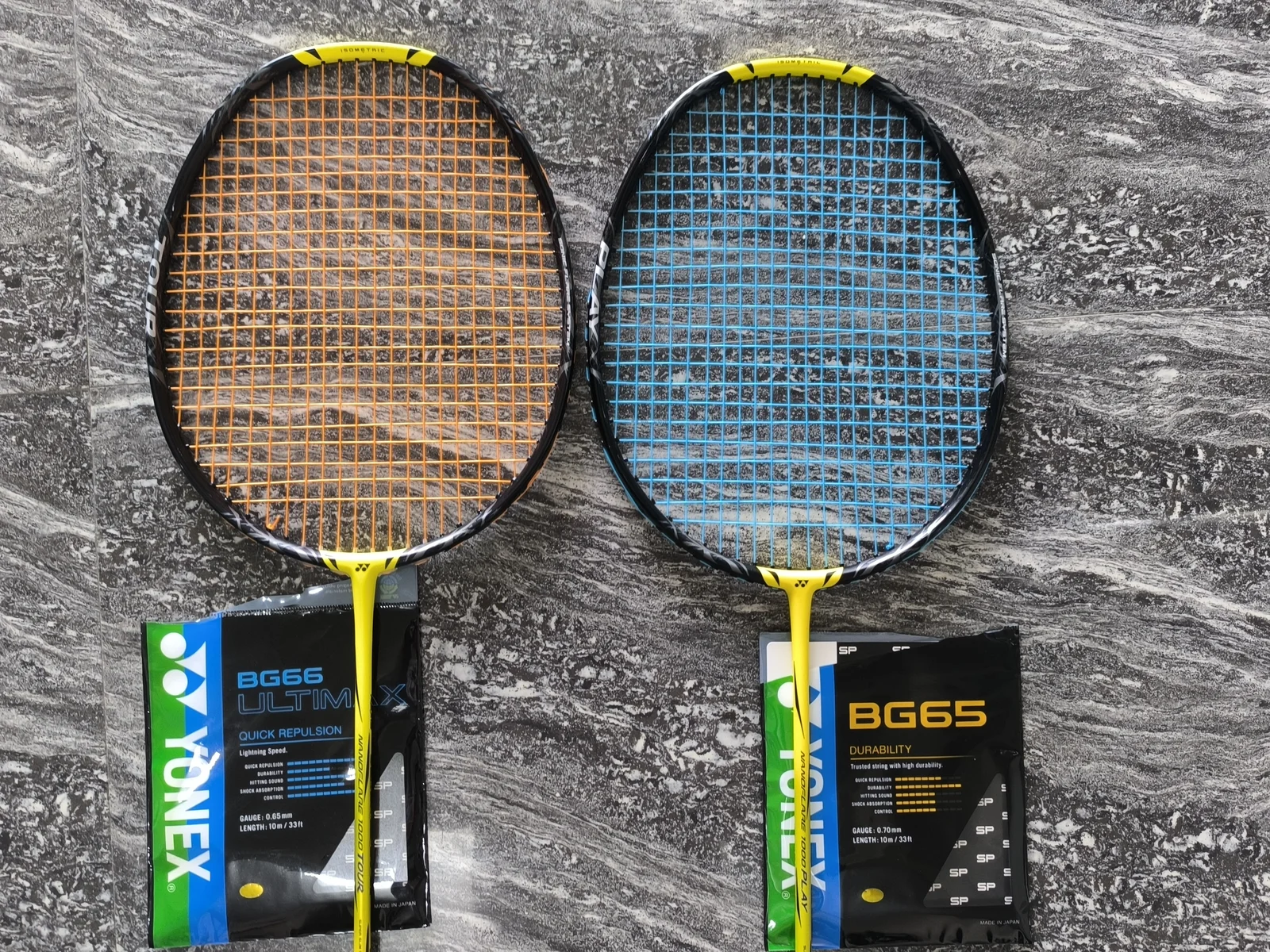
Yonex Nanoflare 1000 Play vs Nanoflare 1000 Tour: the names and lightning-yellow colour are similar, but the rackets are aimed at rather different players. The Play has a medium-flex shaft and a simpler graphite construction. The Tour moves to an extra-stiff shaft and a more sophisticated frame specification. Both belong to Yonex's speed-oriented, head-light Nanoflare family.

First, understand the two rackets
The Nanoflare series is associated with quick racket handling and shuttle acceleration. But the word Nanoflare does not mean every model plays identically. Shaft flex, construction, string choice and even grip build-up can change the response considerably.
Medium flex, 4U weight class and graphite construction. A practical choice for players still developing clean timing and repeatable overhead technique.
Extra-stiff shaft, more advanced frame materials and a choice of 4U or 3U specifications. Better suited to players who already know they prefer a firmer response.
Yonex Nanoflare 1000 Play vs Tour: official specifications
| Specification | Nanoflare 1000 Play | Nanoflare 1000 Tour |
|---|---|---|
| Shaft flex | Medium | Extra stiff |
| Frame | Graphite | HM Graphite, Nanocell NEO, EX-HYPER MG |
| Shaft material | Graphite | HM Graphite |
| Weight | 4U, average 83 g | 4U, average 83 g; 3U, average 88 g |
| Grip sizes | G5 / G6 | 4U: G5 / G6; 3U: G4 / G5 / G6 |
| Length | 10 mm longer | 10 mm longer |
| Yonex stringing advice | 4U: 20–28 lb | 4U: 20–28 lb; 3U: 21–29 lb |
| Colour | Lightning Yellow | Lightning Yellow |
| Model code | NF-1000P | NF-1000T |
Specifications are taken from Yonex's official product listings and catalogue. Market-specific availability may vary. The Tour's 3U option should not be compared directly with a 4U Play without acknowledging the weight difference.
Our custom stringing setups: BG65 at 26 lb vs BG66 Ultimax at 28 lb
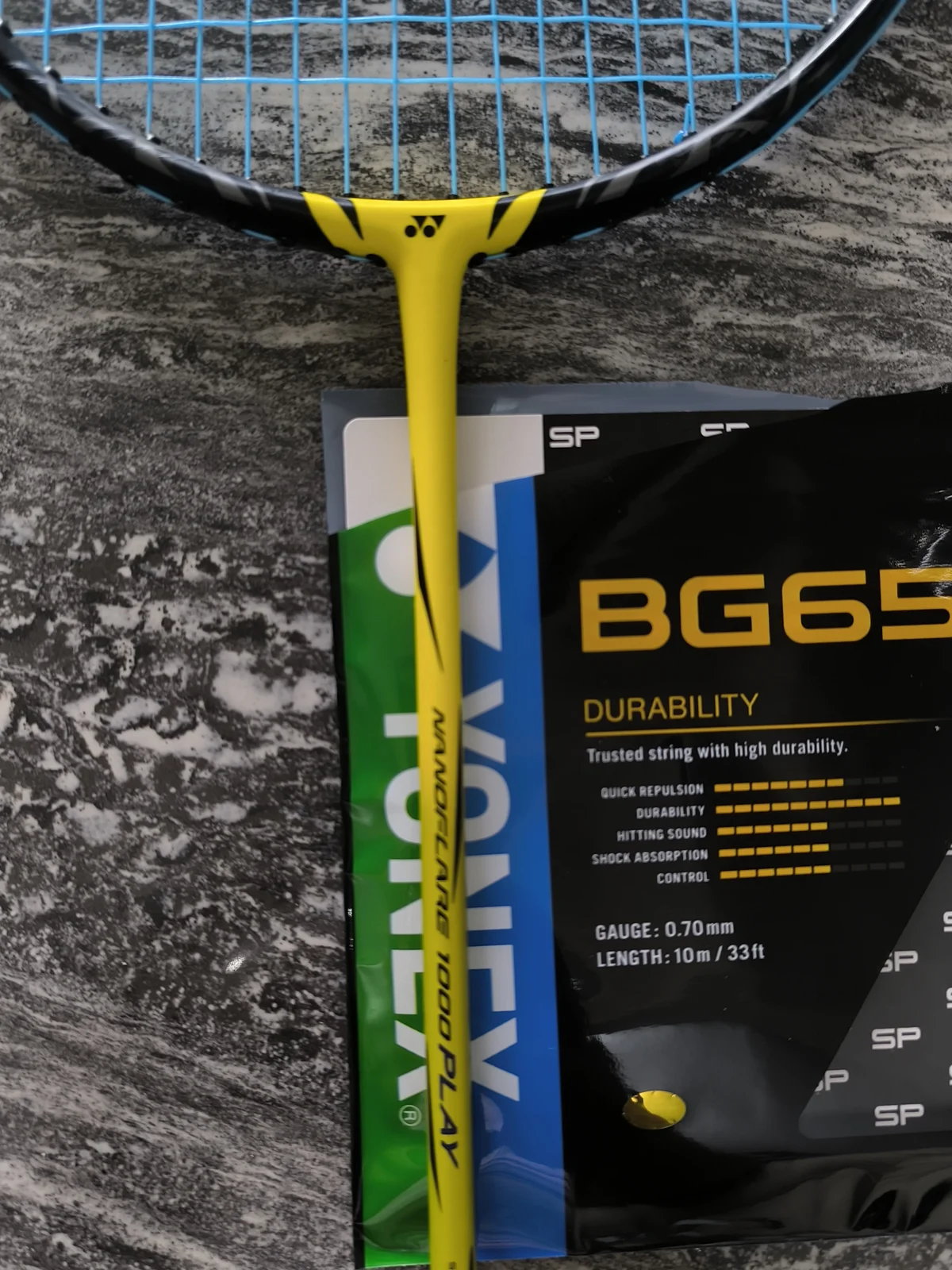
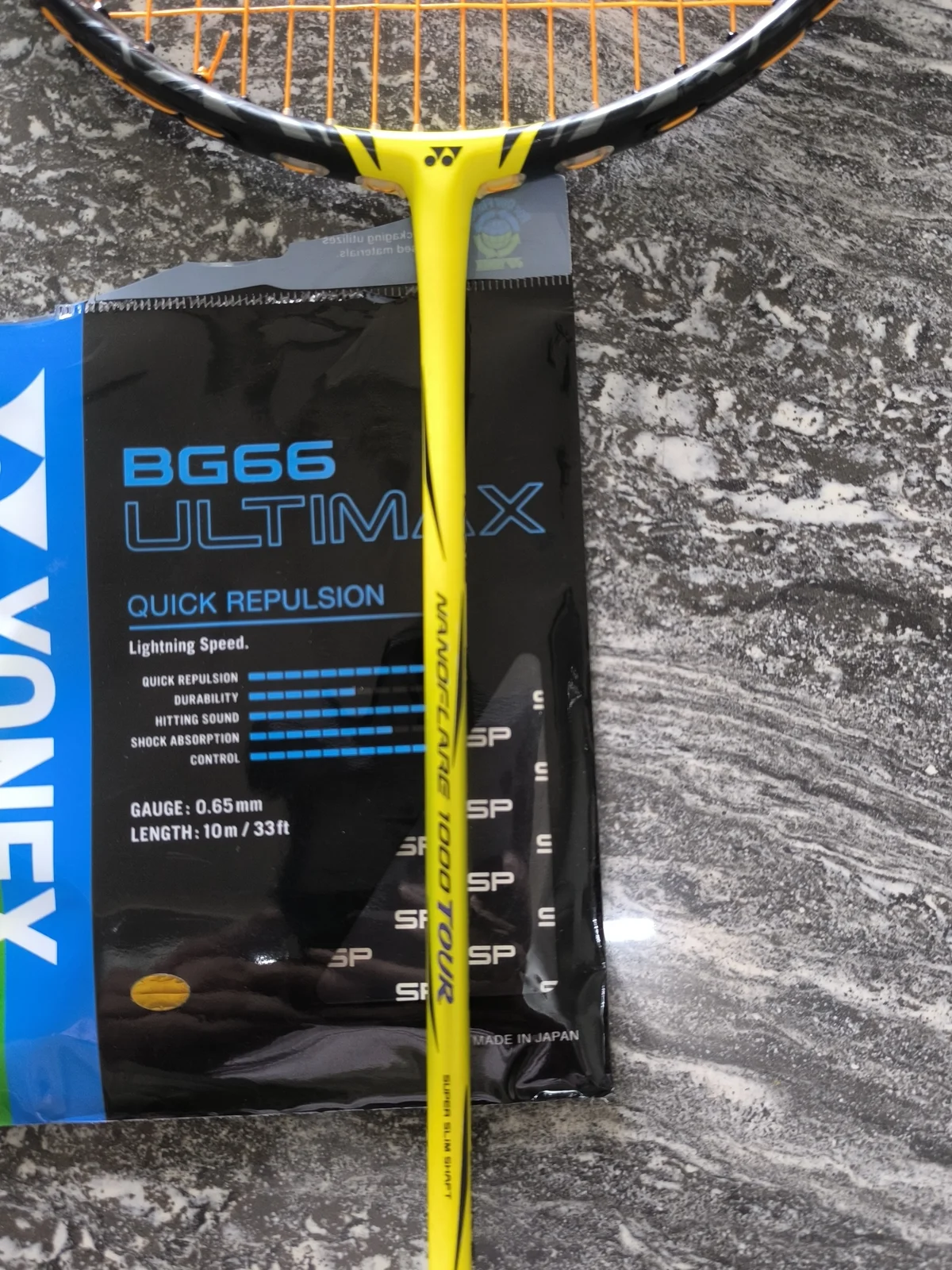
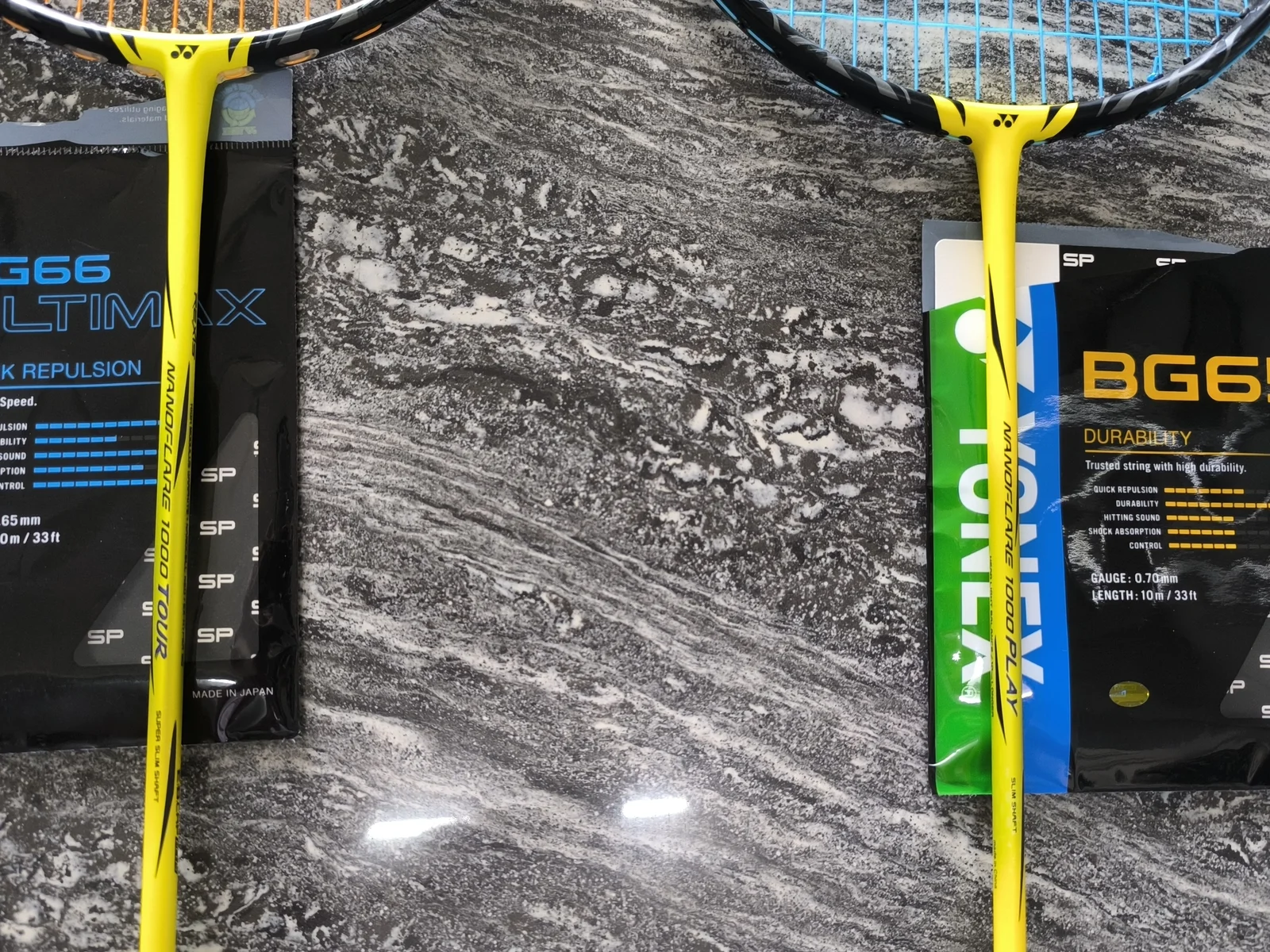
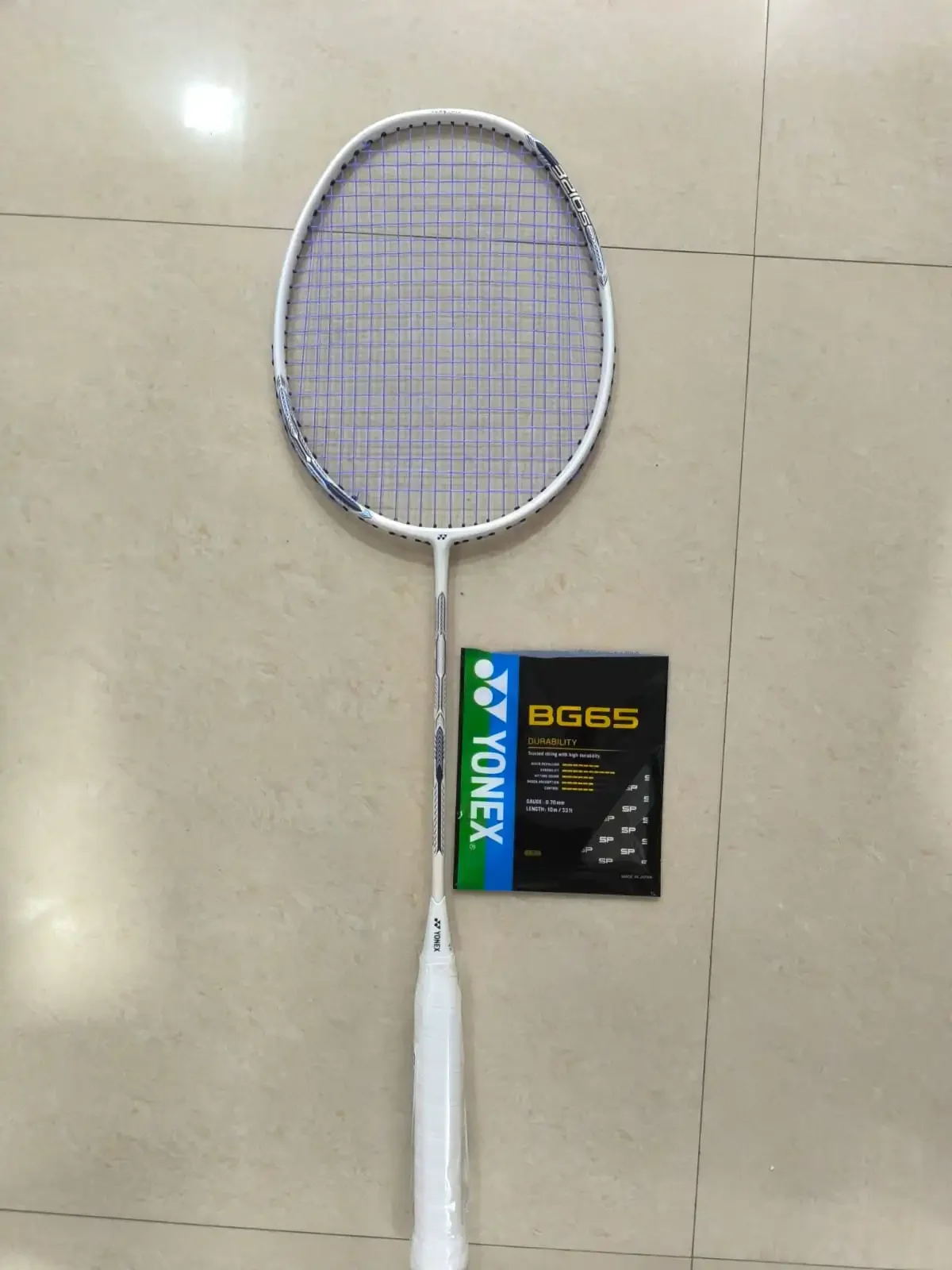
The actual string setups are important here: the Play was strung with 0.70 mm BG65 at 26 lb, while the Tour was strung with 0.65 mm BG66 Ultimax at 28 lb. BG65 prioritises durability; BG66 Ultimax is marketed for quick repulsion. The thinner string can feel livelier, while the higher tension may feel firmer and less forgiving away from the sweet spot. These tendencies are not proof of how either racket performed on court.
What should happen in a fair on-court comparison?
The first thing to control is the test itself. Use the same shuttle speed, court, session and ideally the same player. Alternate the rackets every few rallies rather than testing one fresh and the other after an hour of play. For a fairer equipment comparison, use matching string and tension; if the custom setups differ, report the difference instead of treating the result as a pure frame comparison.
1. Baseline-to-baseline clears
Start with relaxed, high clears before hitting flat attacking clears. The Play's medium shaft may be easier for a developing player to bend and recover, while the Tour's extra-stiff shaft may reward a quicker, cleaner stroke. Neither outcome is guaranteed: timing, string bed and contact point decide how much depth actually appears.
2. Smashes and follow-up shots
Do not judge power from one big smash. Check the consistency of ten overhead attacks, then add a block-and-follow-up drill. The important question is whether the racket helps the player maintain shuttle pace without sacrificing recovery. A stiff shaft does not automatically produce a harder smash.
3. Flat drives and defensive blocks
This is where a speed-oriented racket should be examined carefully. Test rapid forehand/backhand drives, body defence and compact blocks. Both 4U models share the same nominal weight class, so any claim that one swings measurably faster needs a controlled test rather than an assumption from its price.
4. Net control and third-shot response
For the requested third-shot category, use a repeatable serve, return and third-contact sequence. Alternate a net push, tight net reply and attacking lift. Track height over the tape and placement, not just whether the shot lands in. The Tour's firmer shaft may appeal to players who like direct feedback, while the Play may feel more forgiving to others.
5. Backhand clears and backhand defence
Backhand power is particularly sensitive to preparation, grip change and timing. A flexible-feeling racket is not automatically stronger on the backhand, and a stiff racket is not automatically weaker. Record depth, accuracy and how often the player is late to contact.
Performance comparison: what the specifications suggest
These bars show editorial suitability expectations, not measured scores. They are intentionally qualitative; an actual 0–10 performance chart should only be added after testing. The longer bar indicates a stronger predicted fit for a technically confident player, not proven shuttle speed or power.
Where the real differences are likely to matter
Play: an easier entry into fast racket handling
The strongest argument for the Play is not that it can outperform every premium racket. It is that its medium-flex shaft gives a developing player a less demanding starting point. Players who are still learning to generate racket-head speed should prioritise repeatable contact and relaxed technique over an extra-stiff specification.
Tour: more demanding, potentially more rewarding
The Tour's material specification and extra-stiff shaft make it the more performance-oriented design on paper. For someone with a compact, explosive stroke, that firmer response may be desirable on drives, attacking clears and directional net shots. The trade-off is that a player who cannot consistently load the shaft may find it less comfortable or less productive.
Common mistakes when choosing between them
- Assuming the Tour must hit harder: technique and stringing are too important to ignore.
- Comparing different weights: a 3U Tour and 4U Play are not a like-for-like comparison.
- Using high tension as a shortcut to control: excessive tension can reduce forgiveness, especially for developing players.
- Ignoring grip thickness: extra overgrips change the overall feel and effective balance.
- Confusing the Tour with the 1000Z: they are separate models with different specifications and pricing.
Final verdict: which Nanoflare 1000 should you buy?
For a beginner or improving club player, the Nanoflare 1000 Play is the easier recommendation. Its medium-flex shaft and 4U format offer a sensible foundation for learning quicker preparation and more consistent stroke timing.
For an intermediate-to-advanced player who already prefers an extra-stiff racket, the Nanoflare 1000 Tour is the more compelling candidate. The key word is candidate: the more expensive racket is only better if its response suits your technique.
My editorial view is simple: choose the racket that helps you repeat your best shot ten times, not the one that produces the most impressive single hit. Once the customised string setups and actual court observations are available, that is the standard this comparison should be judged against.
Frequently asked questions
It has a more advanced construction and an extra-stiff shaft, but it is not automatically better for every player. The Play may be easier for someone still developing technique.
Both are positioned in Yonex's speed-oriented Nanoflare family, and Yonex USA classifies both models as head-light.
Yonex lists a 20–28 lb stringing range for both 4U models. Your ideal tension depends on technique, string and comfort.
Both can suit fast doubles exchanges. The Play is a reasonable option for developing players; the Tour may suit experienced players who favour a firm response.
Yes. String type, gauge and tension can change repulsion, feedback and forgiveness. Any credible court comparison should disclose both setups.
About the author
Subham Sarkar writes about badminton and cricket equipment for the Khelmart Sports Blog, with an emphasis on explaining specifications in practical terms and helping players make informed buying decisions. This comparison uses published manufacturer information and clearly labelled editorial interpretation; it does not claim unverified first-hand testing.

Comment(s)
No comments yet
Be the first to share your thoughts about this article.
Leave a Comment
Your email address will not be displayed publicly.