
The comparison between the Yonex Arcsaber 11 Pro and the Yonex Astrox 100ZZ is one of the most common debates among badminton players. Many players find it difficult to choose between these two flagship rackets.
At first glance, the decision may seem straightforward: if you prefer a head-heavy racket, the Yonex Astrox 100ZZ is often the recommended choice, while players looking for an even-balanced racket are usually directed toward the Yonex Arcsaber 11 Pro. However, a true comparison goes far beyond racket balance.
Factors such as frame construction, shaft stiffness, material technology, string setup, player compatibility, and real-world on-court performance all play a crucial role in determining which racket is best suited to your game.
At Khelmart, our badminton experts thoroughly tested both rackets under various playing conditions and evaluated their performance in attacking, defensive, control, and all-round gameplay scenarios. Based on these tests, we have developed a detailed comparison that will help eliminate the confusion and guide you toward the right choice between the Yonex Arcsaber 11 Pro and the Yonex Astrox 100ZZ.
Real Question: Is Arcsaber 11 Pro suitable for doubles and Yonex Astrox 100 ZZ for singles?
This is one of the most common misconceptions among badminton players: that the Yonex Arcsaber 11 Pro is primarily a doubles racket, while the Yonex Astrox 100 ZZ is designed mainly for singles players. While there is some logic behind this belief, the reality is far more complex. In most cases, the choice between these two rackets comes down to personal preference, playing style, and what feels most comfortable in your hands.
The reason many players associate the Arcsaber 11 Pro with doubles is its even-balance design. Doubles badminton is a fast-paced game that demands quick reactions, rapid racket exchanges, and excellent control during drives, blocks, and net play. Because of its balanced weight distribution, players often assume that the Arcsaber 11 Pro offers superior maneuverability and therefore must be the better choice for doubles specialists.
However, this assumption overlooks the advanced technologies incorporated into the Astrox 100 ZZ. Although the Astrox 100 ZZ is classified as a head-heavy racket, Yonex has engineered it with technologies that help maintain excellent racket speed and maneuverability. As a result, many players are surprised by how quickly the racket moves through the air despite its power-oriented design. This allows aggressive doubles players to enjoy both fast racket handling and explosive attacking performance.
It is also important to remember that professional players do not always follow the traditional "doubles racket" and "singles racket" categories. A great example is Zheng Si Wei, one of the most successful doubles players in the world. He uses the Arcsaber 11 Pro, and everyone knows the kind of powerful smashes and attacking shots he produces on court. His success demonstrates that a racket's balance point alone does not determine a player's ability to generate power or dominate rallies.
When comparing the two rackets, you may find certain advantages offered by the Arcsaber 11 Pro, such as enhanced control, shot precision, and consistency. On the other hand, the Astrox 100 ZZ is widely appreciated for its explosive power, steep smashes, and strong rear-court performance. Both rackets are exceptional in their own ways, and neither can be universally declared the better option for singles or doubles.
My advice is simple: focus on your personal preference rather than following common assumptions. Consider your playing style, stroke technique, physical strength, and comfort level with the racket. At the end of the day, the racket that complements your game and gives you confidence on court will always perform better than one chosen solely because it is labeled as a "singles" or "doubles" racket.
Yonex Astrox 100 ZZ – Pure Power vs Yonex Arcsaber 11 Pro – Lightning Speed:
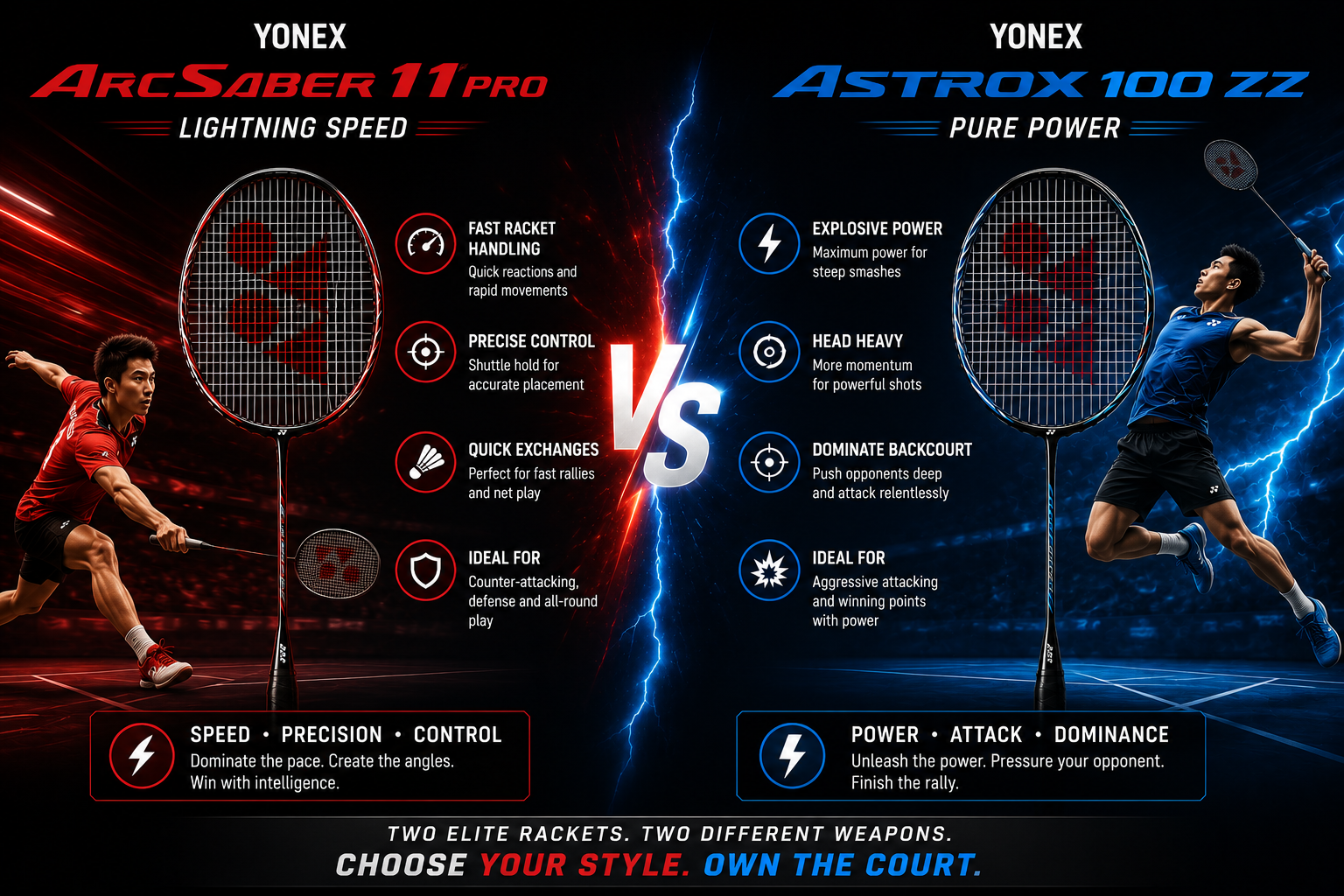
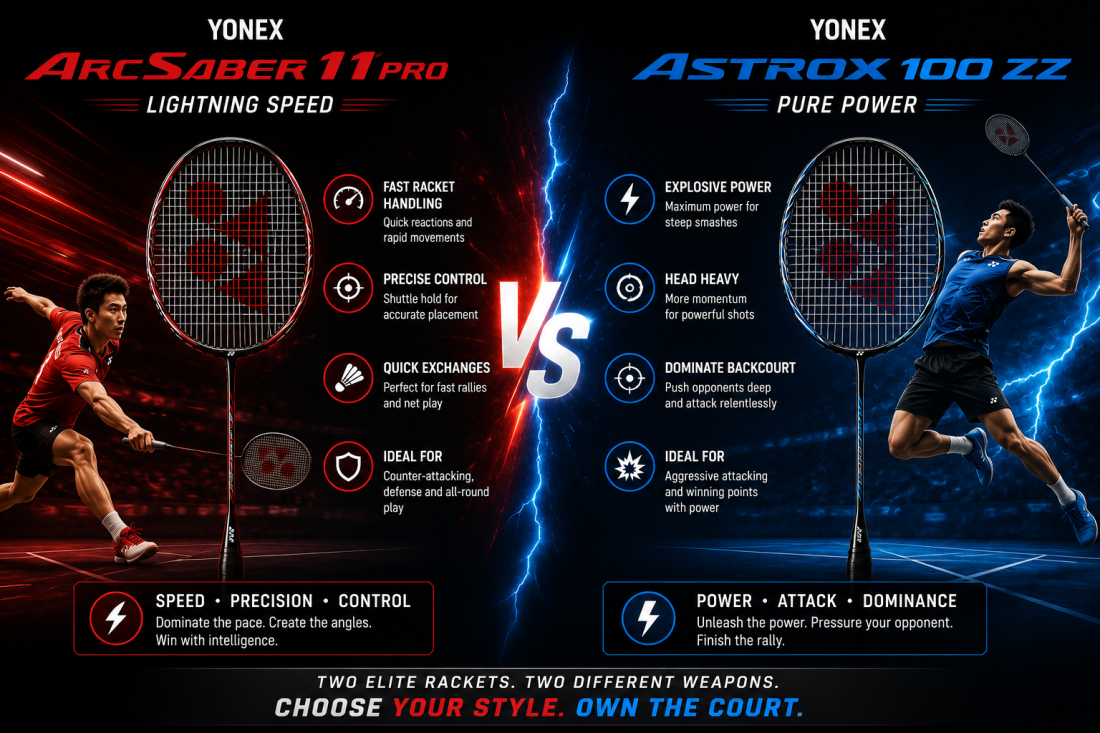
One of the most important factors to understand when comparing the Yonex Astrox 100 ZZ and the Yonex Arcsaber 11 Pro is the difference between power and speed. While both rackets are premium offerings from Yonex, they are designed to cater to different playing preferences and on-court strategies.
The Yonex Arcsaber 11 Pro is built for players who thrive on speed, precision, and quick racket handling. Its even-balance design allows for rapid racket movement, making it an excellent choice for fast rallies, counter-attacking play, defensive recoveries, and quick exchanges at the net. Players who like to control the pace of the game, create angles, and dominate through intelligent shot placement often find the Arcsaber 11 Pro to be the ideal weapon.
On the other hand, the Yonex Astrox 100 ZZ is all about absolute power. With its head-heavy balance and advanced rotational generator technology, it is engineered for players who want to put constant pressure on their opponents through steep smashes and powerful attacking shots. The Astrox 100 ZZ enables players to push opponents deep into the backcourt and then finish rallies with explosive winners when the opportunity arises.
In simple terms, players who prefer super-fast counterattacks, rapid drives, and high-speed rallies will naturally gravitate toward the Yonex Arcsaber 11 Pro. Conversely, players who enjoy controlling rallies through power, forcing opponents onto the defensive, and ending points with devastating smashes will generally prefer the Yonex Astrox 100 ZZ.
Ultimately, neither racket is better than the other. The real question is whether your game is built around lightning-fast speed and control or relentless power and attack. The answer to that question will determine which racket is the better fit for your playing style.
Discover Yonex Rackets Built for Attack, Defense & Precision

Now Let's Move to the Real Comparison – Playing Characteristics:
Specifications and marketing claims only tell part of the story. The real difference between the Yonex Arcsaber 11 Pro and the Yonex Astrox 100 ZZ becomes evident when we analyze their on-court performance and playing characteristics.
In this section, we will compare both rackets across several critical aspects, including power, control, maneuverability, defense, smash performance, net play, and overall feel. This practical comparison will help you understand which racket is better suited to your playing style and game requirements.
Smash Power & Backcourt Performance:
We tested both rackets extensively on court to determine which one delivers better power performance. The testing was conducted in both singles and doubles games and included full smashes, third-line clears, jump smashes, cross-court smashes, and other power-oriented shots.
Based on our testing, the Yonex Astrox 100 ZZ is the clear winner in this category. We would rate it 10/10 for power. The racket delivers effortless clears, exceptional smash penetration, and outstanding power from the rear court. Players looking for maximum attacking performance will immediately notice the difference.
As for the Yonex Arcsaber 11 Pro, let me be very honest. Due to its basic DNA, which focuses more on shuttle hold, control, and precision, players may feel a slight lack of power compared to the Astrox 100 ZZ. The stiff shaft and control-oriented design prioritize shot placement rather than outright power. Therefore, do not expect the same level of smash power that the Astrox 100 ZZ can generate.
That said, if you have a fast swing speed and good technique, the Arcsaber 11 Pro is still capable of producing powerful shots. However, its strength lies more in racket handling, control, and consistency rather than pure attacking power.
Ratings:
Yonex Arcsaber 11 Pro: 8/10
Yonex Astrox 100 ZZ: 10/10
Shop the Complete Collection of Badminton Rackets Online

Control & Shot Placement:
This is the main USP of the Yonex Arcsaber 11 Pro. The racket is built around Yonex's shuttle-hold concept, which allows the shuttle to stay on the string bed slightly longer compared to many other rackets. This additional shuttle hold provides excellent control over shots and enables players to execute pinpoint-accurate placements with greater consistency.
Whether it is net shots, drop shots, cross-court placements, or deceptive strokes, the Arcsaber 11 Pro gives players a greater sense of control and confidence. The racket's design helps players place the shuttle exactly where they want, making it an ideal choice for those who rely on precision and tactical gameplay rather than outright power.
On the other hand, the control offered by the Yonex Astrox 100 ZZ is also very good and more than sufficient for advanced players. However, when comparing both rackets side by side, the Arcsaber 11 Pro is the clear winner in this category. The Astrox 100 ZZ is primarily designed to generate power and attacking performance, whereas the Arcsaber 11 Pro is specifically engineered to maximize control and shot accuracy.
Ratings:
Yonex Arcsaber 11 Pro: 10/10
Yonex Astrox 100 ZZ: 7.5/10
Handling & Maneuverability:
This is again a winning point for the Yonex Arcsaber 11 Pro, as it offers excellent racket handling for players. Its even-balance design perfectly suits the modern game, especially doubles, where fast racket handling and quick reactions are required the most. Whether it is rapid drive exchanges, net interceptions, or defensive recoveries, the Arcsaber 11 Pro feels exceptionally quick in hand.
The Yonex Astrox 100 ZZ also offers very good handling despite being a head-heavy racket. Yonex has incorporated advanced technologies that help improve racket maneuverability and swing speed. However, due to its head-heavy nature, some players may need a little more time to adjust to the racket, particularly during fast-paced exchanges.
For singles players, this difference is often less noticeable because they generally have more time to prepare their shots and position themselves. As a result, many singles players may not find the Astrox 100 ZZ difficult to handle once they become accustomed to it.
Ultimately, racket handling is highly dependent on personal preference and playing style. However, based on our on-court testing and overall experience, we feel that the Yonex Arcsaber 11 Pro has a slight edge over the Yonex Astrox 100 ZZ in terms of handling and maneuverability.
Ratings:
Yonex Arcsaber 11 Pro: 9.5/10
Yonex Astrox 100 ZZ: 8.5/10
Conclusion:
One important factor that players should keep in mind when comparing these two rackets is the head size. The Yonex Astrox 100 ZZ features a compact frame with a smaller head size compared to the Yonex Arcsaber 11 Pro. This compact frame design offers certain advantages, such as increased shuttle repulsion, greater power concentration, and a more solid feel on well-timed shots. However, it also results in a smaller sweet spot, making the racket slightly less forgiving on off-center hits.
In contrast, the Yonex Arcsaber 11 Pro has a more conventional head shape with a larger sweet spot. This makes the racket more forgiving, easier to use consistently, and better suited for players who value control, precision, and shot-making accuracy.
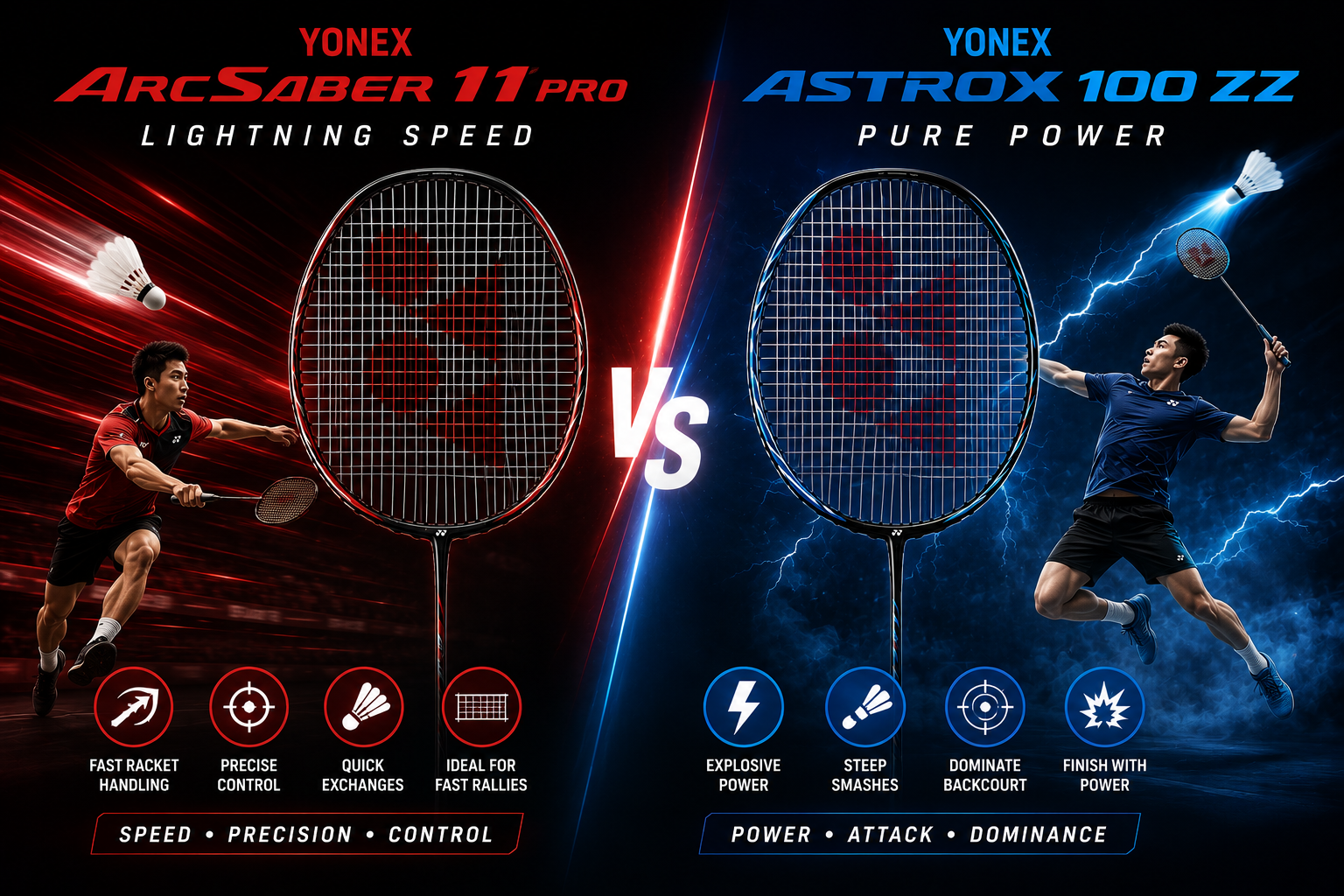
After extensively testing both rackets in singles and doubles play, it is clear that neither racket is universally better than the other. Instead, they are designed for different types of players.
If your game is built around quick racket handling, fast drives, precise shot placement, excellent control, and the unique shuttle-hold feel that the Arcsaber series is known for, then the Yonex Arcsaber 11 Pro is the better choice.
On the other hand, if your primary objective is to generate maximum power, hit steeper smashes, and dominate rallies from the backcourt, then the Yonex Astrox 100 ZZ stands out as the stronger option.
Ultimately, the best racket is the one that complements your playing style. Players who prioritize speed, control, and consistency will likely prefer the Arcsaber 11 Pro, while players who want explosive attacking power and a more aggressive style of play will find the Astrox 100 ZZ to be the better fit. Both are exceptional rackets, and your final decision should be based on what feels most natural and effective in your game rather than on specifications alone.