

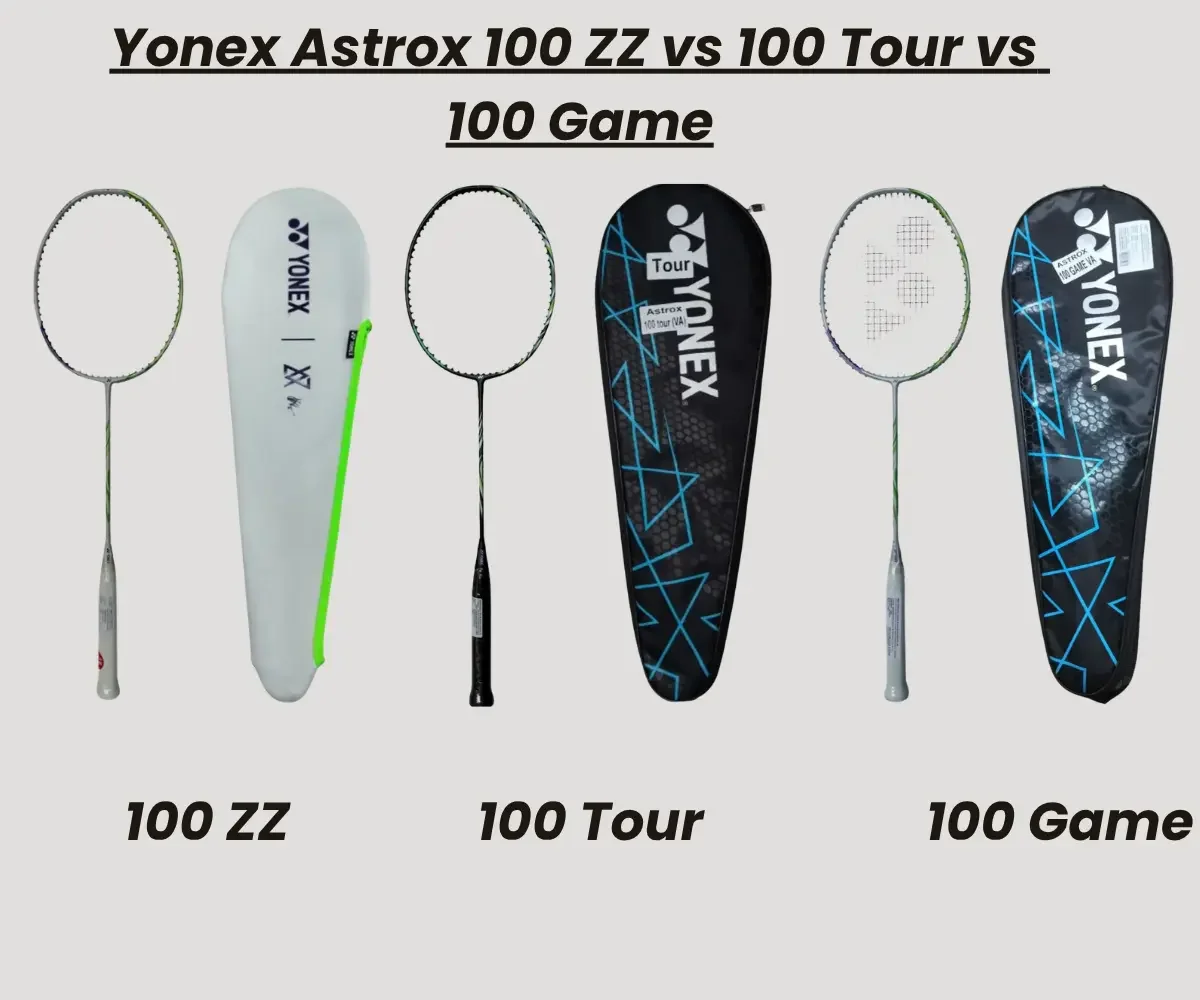
Three Astrox 100 rackets. Three very different answers to the same question: how much racket do you actually need? The Yonex Astrox 100 ZZ, 100 Tour and 100 Game share the attacking DNA of the Astrox family, but the differences are more meaningful than their similar paintwork suggests. If you're choosing between them, don't start with the most expensive one. Start with how you hit the shuttle when you're under pressure.

First, what really separates the three?
All three sit in Yonex's head-heavy Astrox range, so none is designed as a feather-light, purely defensive speed racket. The big split is in the shaft and construction. The ZZ and Tour are extra stiff. The Game is medium flex. That single distinction can matter more than a long list of material names: a demanding shaft rewards a fast, well-timed swing, while a more flexible one can be easier to load when your technique or preparation is less consistent.
The ZZ has Yonex's higher-end construction, including Namd and Black Micro Core in its frame. The Tour retains a Namd shaft but uses Nanomesh Neo in the frame. The Game uses Nanomesh Neo in both frame and shaft. They are not simply three price tags attached to the same racket.
Yonex Astrox 100 ZZ vs Tour vs Game: specifications
| Specification | Astrox 100 ZZ | Astrox 100 Tour | Astrox 100 Game |
|---|---|---|---|
| Shaft flex | Extra stiff | Extra stiff | Medium |
| Balance character | Head heavy | Head heavy | Head heavy |
| Frame materials | HM Graphite, Namd, Tungsten, Black Micro Core, Nanometric | HM Graphite, Nanomesh Neo, Tungsten | HM Graphite, Nanomesh Neo, Tungsten |
| Shaft materials | HM Graphite, Namd | HM Graphite, Namd | HM Graphite, Nanomesh Neo |
| Common weight options* | 3U / 4U | 3U / 4U | 3U / 4U |
| Published stringing range* | 4U: 20–28 lbs; 3U: 21–29 lbs | 4U: 20–28 lbs; 3U: 21–29 lbs | 4U: 20–28 lbs; 3U: 21–29 lbs |
| Best starting point | Advanced, technically consistent attackers | Competitive club players with developed timing | Improving intermediate players |
*Yonex's global specifications list 3U and 4U variants; actual grip sizes, weights, colours and availability vary by market and product listing. Always check the specific Khelmart option before purchase. Manufacturer data: Yonex 100 Tour, Yonex 100 Game and the Yonex product catalogue.
How they differ when the rally gets difficult
It's easy to like a racket during five minutes of comfortable warm-up clears. The more revealing moments come later: you're slightly late to the shuttle, the next drive arrives before your grip has reset, or you need to defend two smashes and still turn the third shot into an attack. That's where racket choice starts to feel personal.
Rear-court smashes: power is not just about a heavy head
The ZZ is built for the player who can accelerate decisively and find the centre of the string bed again and again. With clean timing, its stiff response and stable feel make it an attractive racket for steep, purposeful attacking shots. The catch is that it won't fix a rushed swing. A racket that feels wonderfully direct to an advanced player can feel hard work to someone who is still developing overhead technique.
The Tour is not a soft or beginner-friendly substitute. It is also extra stiff, and it asks you to hit properly. Its appeal is that it offers much of the attacking character of the ZZ at a lower price. In independent testing, CK Yew found the 4U Tour smooth to swing, solidly head heavy and capable of producing strong power with good timing, while feeling a little slower than the 100 ZZ.
The Game takes a different approach. Its medium-flex shaft can be more cooperative when the player cannot consistently produce a very fast swing. That doesn't automatically mean a bigger smash: an accomplished hitter may prefer the directness of the stiffer models. But for a developing player, a racket that is easier to use repeatedly is often the one that produces the better result across a full match.
Defence: the second shot matters as much as the first
In doubles, the problem with a head-heavy racket is rarely the first defensive block. It's recovering in time for the next shuttle. The ZZ and Tour reward compact technique, an early racket position and a quick grip change. If your defence depends on last-second wrist flicks, both can expose that weakness. A 4U version will generally be easier to manoeuvre than the corresponding 3U, although individual preferences and string setups matter.
The Game's more flexible shaft makes it a sensible option for a player who wants Astrox-style attacking intent without such a demanding response. That doesn't make it a dedicated defensive racket; it's still an attacking-oriented design. But it is the easiest of these three to recommend to someone whose game includes plenty of rushed, imperfect contacts.
Flat drives and fast exchanges
During quick drive battles, the winner is often the player who can prepare the racket head early, not the player holding the most expensive frame. The ZZ can feel exceptionally crisp in skilled hands. The Tour offers a similarly direct response but is not quite the same racket through the air. The Game is less demanding of timing, though a strong player may find its softer response less precise during aggressive exchanges.
For a front-court doubles specialist whose main weapon is interception speed, it is worth asking whether a head-heavy Astrox 100 is the right family at all. You can explore other options in Khelmart's badminton racket collection rather than forcing yourself into a racket that doesn't suit your role.
Net shots, drops and placement
None of these rackets places the shuttle for you. Good touch still comes from relaxed fingers, a consistent contact point and the right string setup. The ZZ's firm, direct response can appeal to players who know exactly what they want from the string bed. The Tour gives experienced players a similar style of feedback without the flagship price. The Game is likely to feel more accommodating during learning, but it won't automatically produce more accurate net shots.
Clears and long rallies
If you can already clear baseline to baseline without straining, the ZZ and Tour let you make use of a quick, well-timed overhead action. If you regularly struggle to reach the rear court, choosing an extra-stiff racket because professionals use it may be counterproductive. The Game's medium flex is the more sensible place to start, along with attention to technique and an appropriate string tension.
Three rackets, three honest verdicts
Choose it if: your timing is reliable, you generate your own racket-head speed and you enjoy a very direct attacking response.
Think twice if: you are still learning overhead technique, often hit late, or expect a premium racket to create power for you.
Choose it if: you are an established club or tournament player, like head-heavy rackets and specifically want an extra-stiff shaft.
Think twice if: you want a forgiving shaft or mostly rely on quick, improvised defensive shots.
Choose it if: you're improving your attacking game and want a medium-flex racket that is less exacting than the Tour or ZZ.
Think twice if: you already know you prefer very stiff shafts and sharp, immediate feedback.
Is the Astrox 100 ZZ worth paying extra for?
Sometimes, yes. But only if you can actually use what you're paying for. The ZZ's higher-end construction and demanding feel are meaningful to players who hit cleanly and want a specific response. For everyone else, the price gap is not a reliable measure of how many points they'll win.
For a committed club player with good timing, the Tour is the most interesting buying decision in this range. It doesn't pretend to be soft or effortless. It gives you an extra-stiff, head-heavy setup with serious attacking intent, without requiring the ZZ's price. If you are not comfortable with extra-stiff rackets, however, the Game may be the better purchase regardless of budget.
Singles or doubles: which one makes more sense?
Attacking singles: The ZZ is compelling for advanced players who set up their strokes early. The Tour is a strong alternative for confident, technically developed players. The Game is a practical option for intermediates building consistent overhead power.
Rear-court doubles: The Tour and ZZ can both suit an attacker who wants to hit down from the back. If your games are very fast and you struggle to recover after smashes, pay particular attention to weight class and handling rather than assuming more head weight is always better.
Front-court doubles: None is the automatic first recommendation for a player who prizes rapid interceptions above everything else. Compare them against more speed-oriented rackets from the Yonex badminton racket range.
What about 3U versus 4U?
The same model can feel quite different in different weight classes. A 3U racket is typically heavier than a 4U racket; that can feel more substantial during a full swing but may be more demanding during repeated defensive reactions. A 4U is often the safer starting point for players who want easier manoeuvrability.
Don't make the choice from weight alone. Grip size, string type, string tension, balance, and your own swing mechanics all change the experience. The product variant sold in India may also differ from the options listed in Yonex's global catalogue.
String tension: don't make a stiff racket harder than it needs to be
One common mistake is pairing an extra-stiff racket with very high tension before the player has developed the technique to use it. Higher tension can produce a firmer, more precise feel for a clean striker, but it generally demands better timing and consistent contact. Lower tension can feel more forgiving. Neither choice is universally better.
Yonex publishes a 20–28 lbs stringing range for the 4U Tour and Game and 21–29 lbs for their 3U variants. Check the exact model and weight before stringing, and don't treat the upper limit as a recommended starting point. Your stringer should consider playing level, string model and durability as well as the printed maximum.
Questions players ask before buying
No. Both are extra stiff and head heavy, but their construction differs. The Tour offers a similar attacking direction at a lower price, not an identical on-court feel.
Yes, especially players developing an attacking game. Its medium-flex shaft is generally more approachable than the extra-stiff Tour and ZZ.
There is no universal winner for every player. A strong, technically consistent attacker may get excellent results from the ZZ. A developing player may hit better, more repeatable smashes with the Game. The Tour is a compelling middle choice for a player comfortable with extra stiffness.
If you already enjoy extra-stiff rackets and have reliable timing, look at the Tour. If you want more flexibility and easier access to an attacking feel, start with the Game.
They are separate listings with special styling. Compare the exact manufacturer specifications and variant details rather than assuming that every special edition is identical to an older colourway.
How this comparison was prepared
This is an editorial buying guide based on published Yonex specifications, Khelmart's product information and independent badminton reviews. It is not presented as a first-hand Khelmart court test. Playing feel varies with player technique, racket weight, strings and tension. For independent on-court impressions, see CK Yew's three-racket comparison and Beast Badminton's 100 Game review.


Comment(s)
No comments yet
Be the first to share your thoughts about this article.
Leave a Comment
Your email address will not be displayed publicly.