
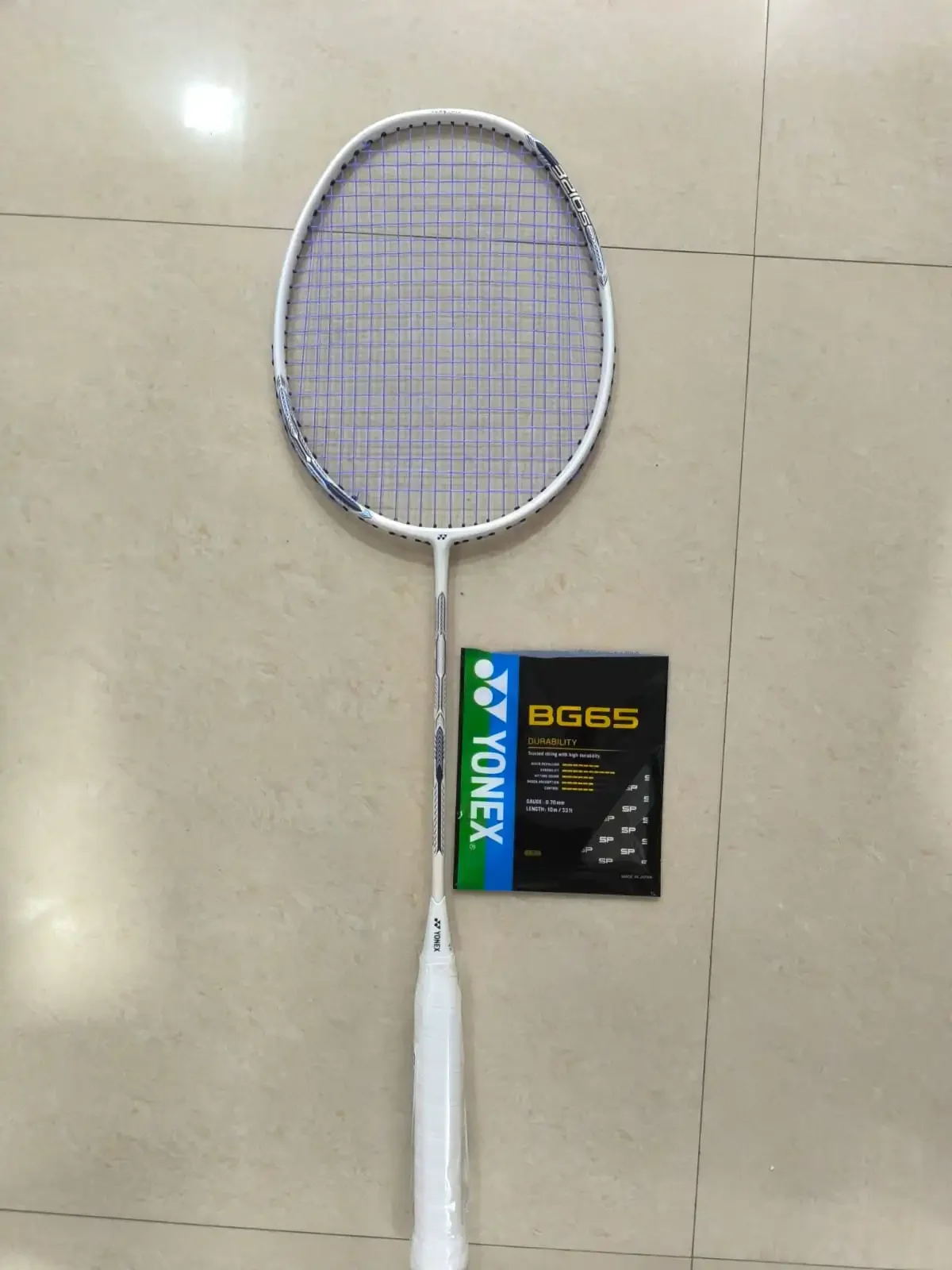
A head-heavy badminton racket at an accessible price is easy to recommend on paper. The more interesting question is what happens when you replace its strings. For this close look at the Yonex Astrox Attack 9 with Yonex BG65, we have photographs of the actual racket and string packet, verified published specifications, and a careful explanation of what the combination should—and should not—deliver.

What makes this setup interesting?
The Attack 9 sits in an appealing middle ground: it is not an ultra-light defensive racket, yet its flexible shaft makes it approachable for players who do not generate a very fast swing. Khelmart lists it at approximately 84 g, with a 305 mm head-heavy balance point, a G4 grip, and a flexible shaft. Those are retailer-published figures, not measurements taken from the photographed sample.
BG65 is a different kind of decision. Yonex describes it as a 0.70 mm string with a specially braided outer fibre intended for abrasion durability. It is a sensible option for players who value string life and a familiar, solid response rather than chasing the sharpest possible initial feel.
| Detail | What is documented | Why it matters |
|---|---|---|
| Racket | Yonex Astrox Attack 9 | Attacking-oriented Astrox model |
| Weight / grip | Approx. 84 g / G4 (Khelmart listing) | Substantial enough to feel the head during a swing |
| Balance | Head-heavy; listed at 305 mm | Can help with momentum in overhead strokes, but may feel slower in rapid exchanges |
| Shaft | Flexible | May suit developing or moderate swing speeds |
| String shown | Yonex BG65, 0.70 mm | Durability-focused string choice |
| Actual tension | Not supplied | Essential before drawing conclusions about feel or repulsion |
A closer look at the racket and restringing
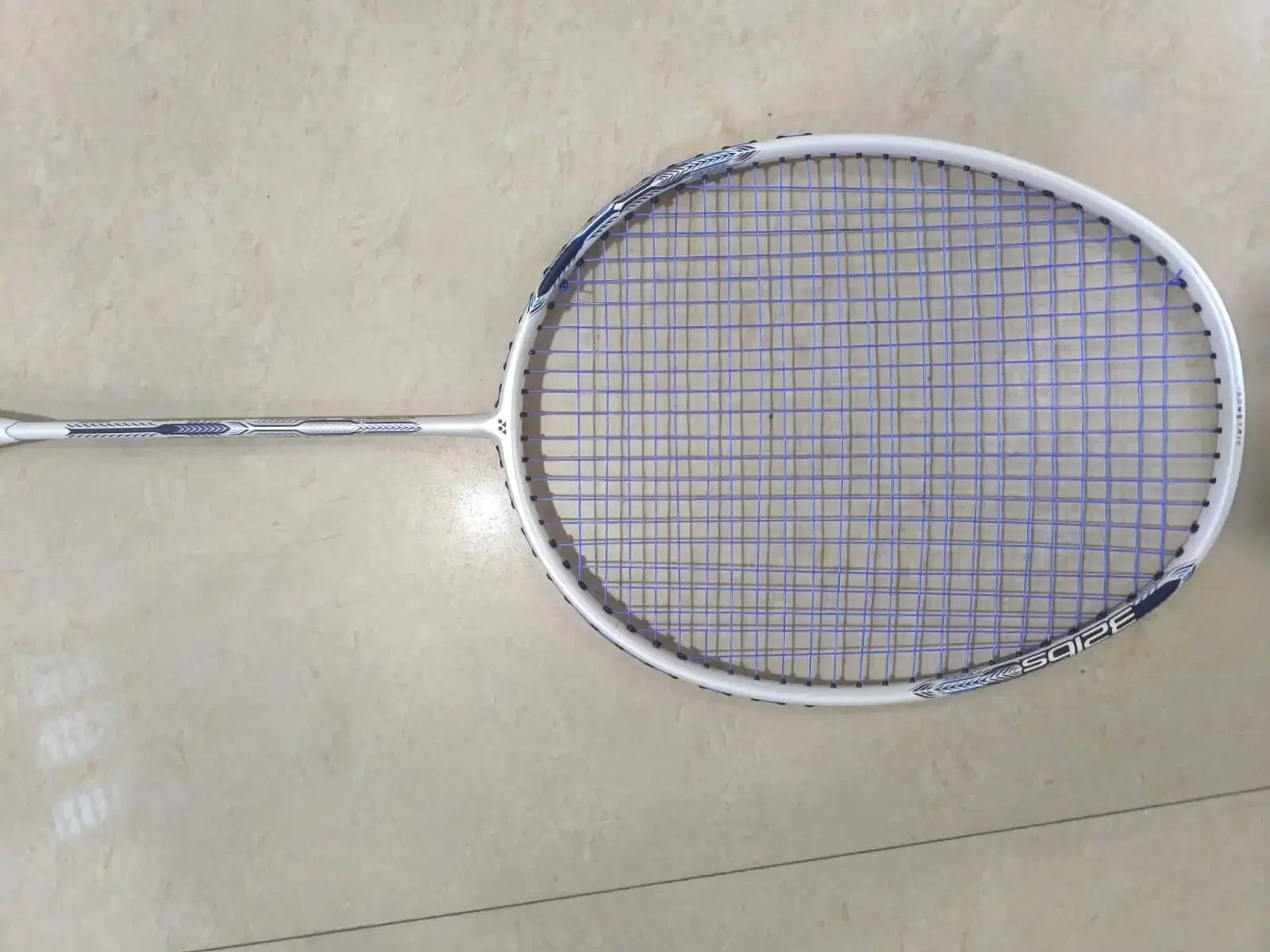
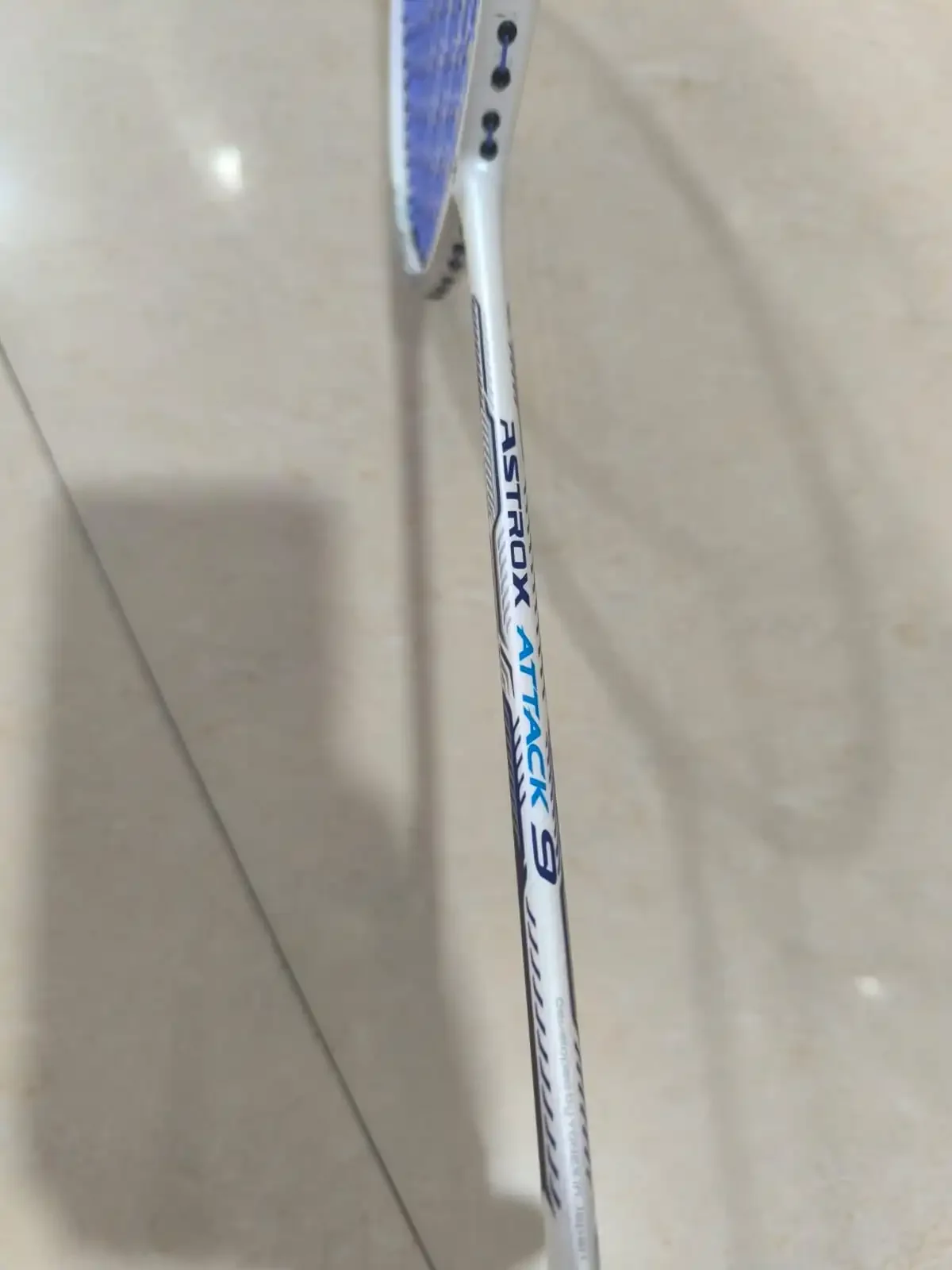
What stands out visually is the clean white frame and the blue string bed. The BG65 packaging is visible in the first photograph. There is no visible tension reading or stringing-machine record, so it would be misleading to claim this particular job was strung at 24, 26 or 28 lb.
That missing detail matters more than many buyers realise. Two identical Attack 9 rackets strung with BG65 at different tensions can feel noticeably different. Lower tensions generally offer a more forgiving string bed; higher tensions tend to demand cleaner timing and a more consistent contact point. Neither setting automatically guarantees a harder smash.
Performance profile: power, control, speed, smash and repulsion
Rather than publish made-up 8/10 ratings, this chart shows the likely character of the setup based on the listed racket design and BG65's published construction. The markers are qualitative editorial estimates, not measurements or results from Subham Sarkar's court testing.
Chart method: qualitative assessment from documented equipment characteristics. Marker positions are visual illustrations only; they are not numeric ratings, lab results or comparative test data.
Power and smash: will BG65 make the Attack 9 stronger?
Not by itself. The racket's head-heavy construction may help a player carry momentum through an overhead shot. A flexible shaft can feel easier to load for some players, particularly those still developing their swing. But shuttle speed comes from the whole movement: positioning, preparation, rotation, timing and a clean strike.
BG65 is often chosen for durability. Compared with a thinner, livelier-feeling string, it may not give every player the same crisp sensation at contact. That is not necessarily a drawback. A player who breaks strings frequently may prefer the trade-off. If your main goal is a sharper response, it is worth discussing alternative strings and tension with a qualified stringer rather than assuming that higher tension is always better.
Control and net play: where technique matters more
At the net, the Attack 9's balance is likely to feel different from a genuinely head-light racket. For controlled pushes and lifts, the setup can still be perfectly usable; what matters is whether the player can prepare early and keep the racket head stable. In fast doubles defence, some players will prefer a lighter-feeling head for quicker changes of direction.
BG65 can give a reassuring, durable string-bed feel, but accurate drops and tight net shots are not properties a string can deliver on its own. Grip pressure, touch and contact point matter much more than a marketing description.
Who should consider this combination?
- Developing attacking players: The flexible shaft and head-heavy layout make this a logical model to consider, provided the overall weight feels comfortable.
- Club players who break strings: BG65's durability-oriented construction may be more useful than a very thin string.
- Singles players who rely on clears and overheads: Worth trying if they enjoy feeling some racket-head weight.
- Fast doubles defenders: Try before committing; a more head-light model might feel quicker at the net.
What I would check before calling this a full on-court review
A meaningful test should record the actual tension, stringing date, shuttle type, playing conditions and number of sessions. I would also compare the racket against its previous string setup, if available, using the same player and similar shuttles. Only then could we make credible statements such as “the clears felt easier” or “the racket was slower in defence.”
Until those notes are available, this is a detailed equipment assessment supported by photographs and specifications—not a claim that Subham Sarkar personally completed a timed or instrumented court test.
Verdict: a sensible attacking setup, with one important caveat
The Yonex Astrox Attack 9 with BG65 is a credible combination for players who want a head-heavy, flexible racket and a durability-focused string. The racket's specification points toward overhead play; the string choice points toward reliability. What remains unknown is how this exact photographed setup performs at its actual tension on court.
For anyone comparing options, see the Astrox Attack 9 product page, explore Yonex badminton rackets, or browse all badminton rackets at Khelmart.
Common questions
Is Yonex BG65 a good string for smashing?
It can work well for smashing, especially when durability matters. However, BG65's 0.70 mm construction is not a guarantee of greater smash speed. The right tension and a clean hitting technique matter.
What tension was used in these photographs?
The tension was not provided, and it cannot be confirmed visually. Do not use an assumed tension as the basis for a purchase or restringing decision.
Is the Astrox Attack 9 head-heavy?
Yes. Khelmart's product listing describes it as head-heavy and gives a 305 mm balance point. Actual balance may change slightly with strings, grip and manufacturing variation.
Is this racket suitable for doubles?
It can be used for doubles, especially by players who like an attacking setup. Those who prioritise rapid flat exchanges and defensive reactions may prefer to compare it with a head-light racket.
Sources and product references
- Khelmart: Yonex Astrox Attack 9 — retailer-listed weight, balance, shaft and grip information.
- Yonex: BG65 — manufacturer string gauge, construction and durability positioning.


Comment(s)
No comments yet
Be the first to share your thoughts about this article.
Leave a Comment
Your email address will not be displayed publicly.