
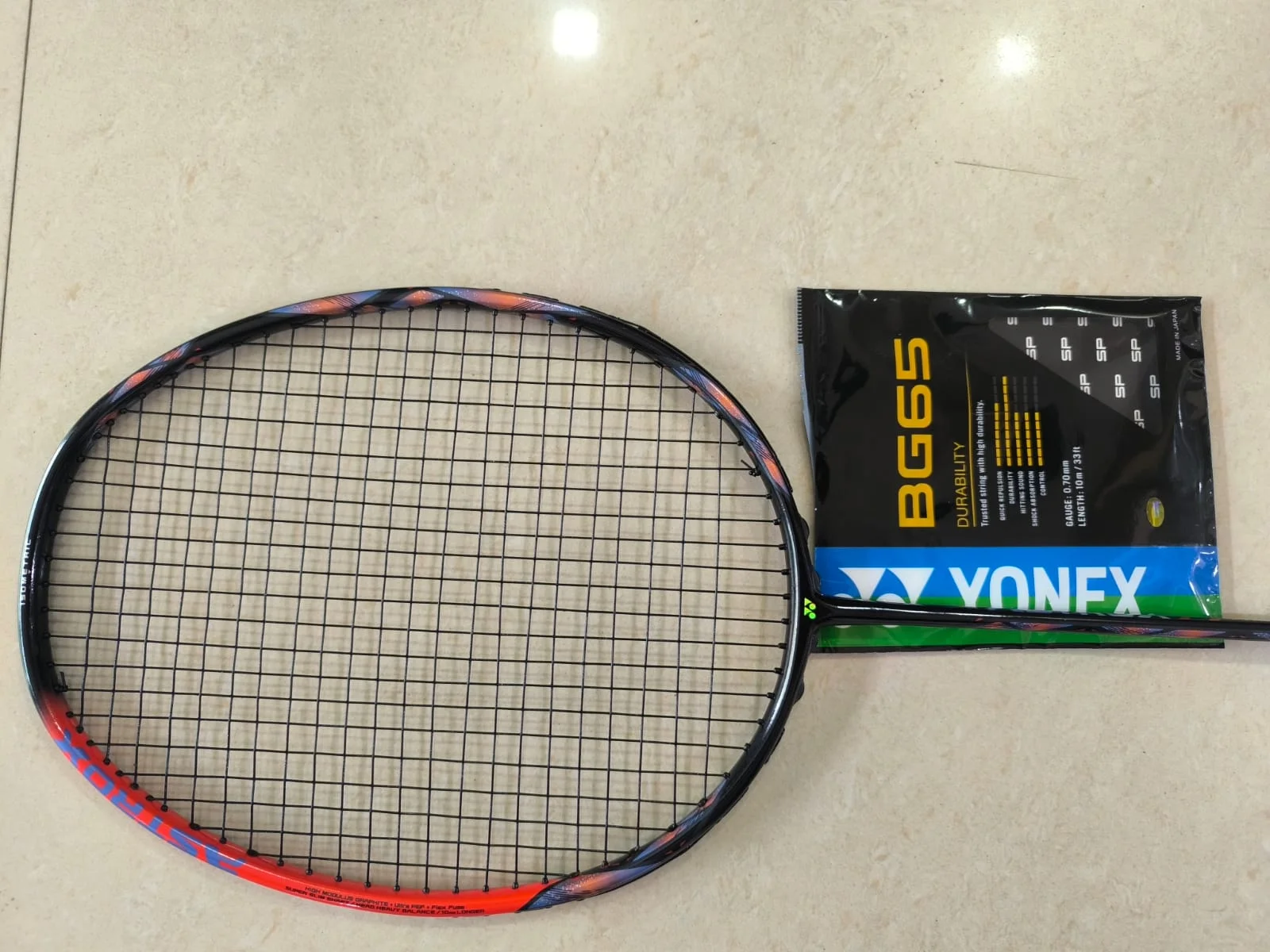
Yonex Astrox 77 Pro review, tested on court by Subham Sarkar. Some badminton rackets impress you with speed, others with control. The Astrox 77 Pro made its strongest impression on me with power. Deep clears felt particularly satisfying, and when I had the time to prepare for a full smash, the racket delivered the kind of attacking response I look for in a head-heavy frame.
My verdict is straightforward: if your game needs more help from the backcourt, the Astrox 77 Pro deserves serious consideration. Its overhead power is excellent, its control is good, and its main weakness is a slightly sluggish feel during fast drives. That last point matters, especially in quick doubles exchanges. This is a racket with a clear personality, not a perfect answer for everyone.
Quick verdict: Best suited to players who prioritise deep clears, attacking overhead strokes and powerful smashes over the quickest possible flat-drive exchanges. These are my qualitative court impressions, not laboratory measurements.
What I noticed during the on-court test
Backcourt clears: the standout strength
The first thing that stood out was how confidently the racket handled overhead clears. From deep in my court, I could send the shuttle towards the opponent's back boundary with a satisfying sense of weight behind the stroke. Even third-line clears felt convincing. For players who often struggle to push an opponent back, this is one of the Astrox 77 Pro's most attractive qualities.
Of course, a racket cannot replace sound technique. You still need good timing, shoulder rotation and clean contact. But when those fundamentals are in place, the head-heavy balance and medium-flex shaft make a useful combination for an attacking overhead game.
Smashes: massive power when you prepare properly
This is where I enjoyed the racket most. On full overhead smashes, the Astrox 77 Pro produced massive power. The head-heavy feel rewards a committed swing, and the shuttle comes off the string bed with a strong, attacking sensation.
What I especially like is that you do not need to choose an extremely stiff shaft to get a serious attacking racket. Yonex rates the 77 Pro as medium flex. In practical terms, that can make the racket more approachable for players who have a developed swing but do not consistently load an extra-stiff shaft. This is an explanation of the design and my impression, not a promise that every player will smash harder.

Control: better than a power-first label suggests
Power was the headline, but the Astrox 77 Pro did not feel like a one-dimensional racket. I found its overall control good. That matters because a useful attacking racket should still let you change placement, keep the shuttle in play and build a rally rather than simply swing harder at every opportunity.
Flat drives: the compromise you should know about
During rapid drive exchanges, I noticed a little sluggishness. The racket did not feel quite as effortless to redirect as I would want from a speed-first setup. This is not a deal-breaker, but it is the part of the test I would tell a doubles player about before recommending it.
If most of your points are played through quick interceptions, flat exchanges and rapid defensive changes, pay attention to this trade-off. A racket that helps on a full overhead swing can demand more work in short, reactive movements.
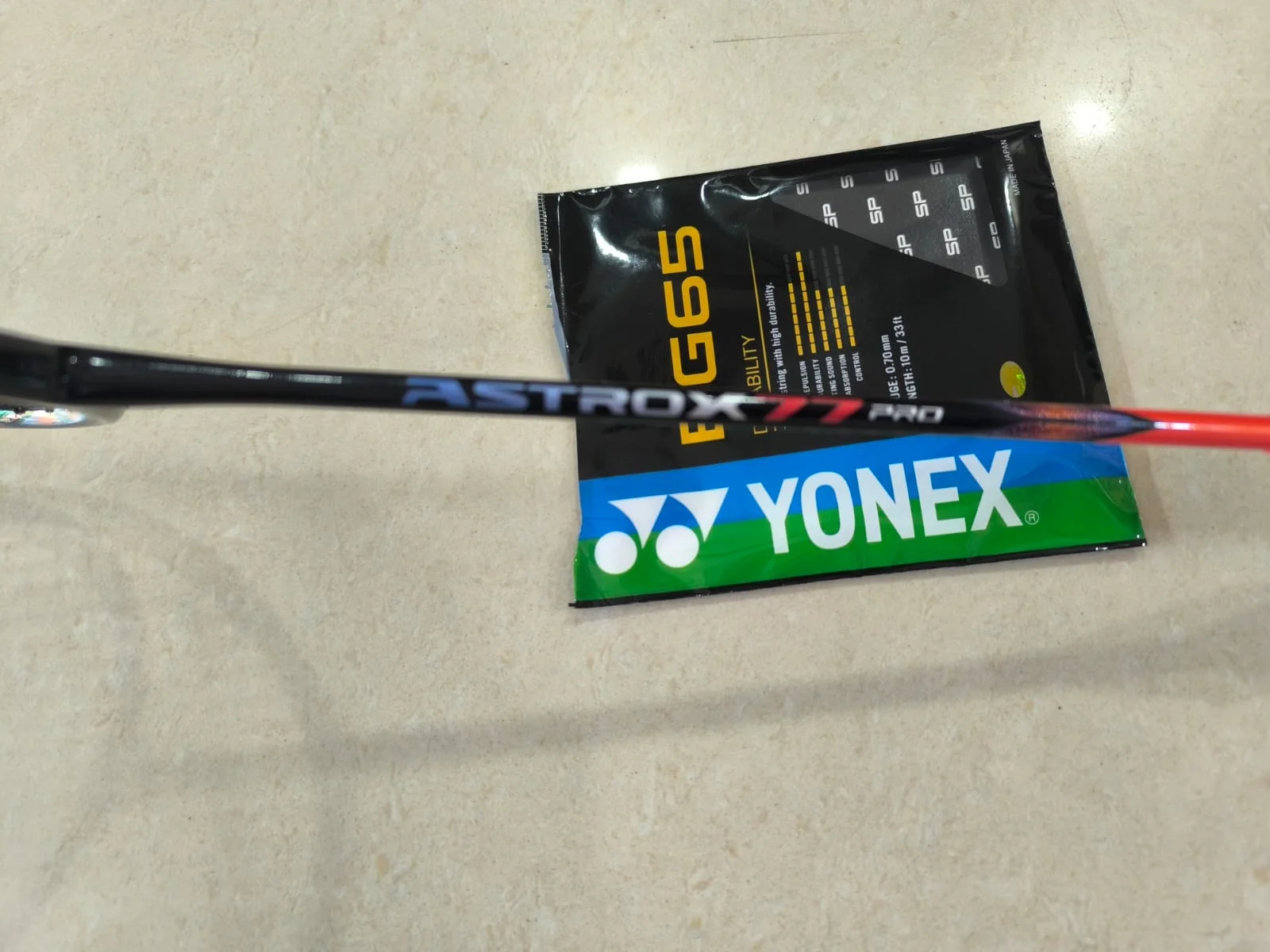
Yonex Astrox 77 Pro specifications
These are manufacturer specifications, separate from my playing impressions. Regional availability of weight and grip combinations may differ.
| Specification | Yonex Astrox 77 Pro |
|---|---|
| Balance | Head heavy |
| Shaft flex | Medium |
| Weight options | 4U (average 83 g); 3U (average 88 g) |
| Grip options | 4U: G5/G6; 3U: G4/G5/G6 |
| Frame | HM Graphite, Flex Fuse, Tungsten |
| Shaft | HM Graphite, Namd, Ultra PE Fiber |
| Joint | New Built-in T-Joint |
| Length | 10 mm longer |
| Official stringing advice | 4U: 19–27 lbs; 3U: 20–28 lbs |
| Colour | High Orange |
| Manufacturing country | Japan |
Source: Yonex official Astrox 77 Pro specifications and Yonex USA product information.
Why power-seeking players should consider the Astrox 77 Pro
Many players ask for a more powerful racket, but what they really want is better length on clears and more authority on smashes. These are related but not identical requirements. A clear needs depth and repeatability; a smash needs timing, acceleration and a clean, aggressive contact point.
The 77 Pro's head-heavy balance is a logical fit for players who enjoy using the full overhead swing. Its medium-flex shaft also distinguishes it from some more demanding, extra-stiff attacking rackets. In my test, the result was a particularly strong backcourt performance.
That makes it worth considering for intermediate and advanced club players who build rallies from the rear court, enjoy attacking the shuttle and want a racket that still gives them usable control. I would be more cautious about recommending it to someone whose main priority is lightning-fast front-court racket handling.
Astrox 77 Pro vs Astrox 100 ZZ vs Arcsaber 11 Pro
These three Yonex rackets are not simply different price points for the same playing style. Their published designs suggest different priorities. The 77 Pro observations below come from my court test; the other two assessments are based on Yonex's official specifications and design descriptions, not a claimed side-by-side test.
| Factor | Astrox 77 Pro | Astrox 100 ZZ | Arcsaber 11 Pro |
|---|---|---|---|
| Primary character | Power-focused with accessible shaft flex | More demanding, precision-oriented attacking setup | Control and shuttle placement |
| Balance | Head heavy | Head heavy | Even balanced |
| Official shaft flex | Medium | Extra stiff | Stiff |
| Best reason to consider | Deep clears and powerful overhead play | Experienced attacker wanting an extra-stiff response | Player prioritising stable, controlled shot-making |
| Main buying caution | Can feel a little slow in drives | Extra-stiff feel may not suit every swing | Not as specifically power-oriented as the Astrox models |
Visual comparison: power, speed, clears and net play
How to read these graphs: Longer bars indicate a stronger relative suitability for that aspect of play, not measured shuttle speed, swing speed or laboratory performance. They are illustrative editorial estimates based on the Astrox 77 Pro court impressions and Yonex's published design specifications for the other two models. Stringing, technique, weight version and player preference can change the result. *Values are subjective editorial illustration scores, not laboratory measurements.
Smash power
Both Astrox rackets favour attacking play. The 100 ZZ may offer a more direct response for a strong, well-timed swing; the 77 Pro was impressive for powerful smashes in the actual court test.
Swing speed
The even-balanced Arcsaber is the more natural choice for rapid racket exchanges. The 77 Pro felt slightly sluggish on drives in the on-court test.
Third-line / deep backcourt clears
Deep overhead clears were a particular strength of the tested 77 Pro. The extra-stiff 100 ZZ may reward faster, more technically consistent swings; these are not measured clear distances.
Net play and control
The Arcsaber 11 Pro has a control-focused design and should appeal to players prioritising delicate net placement and quick preparation. The 77 Pro still offered good control in the test.
Buying takeaway: Pick the Astrox 77 Pro for accessible rear-court power and deep clears, the 100 ZZ if you are comfortable with an extra-stiff attacking racket, or the Arcsaber 11 Pro when quick handling and precise net play matter most.
Against the Astrox 100 ZZ
The 100 ZZ has an extra-stiff shaft, while the 77 Pro is medium flex. That difference is central to the buying decision. A technically strong player who likes a direct, firm response may prefer the 100 ZZ. Someone who wants a powerful head-heavy racket without committing to an extra-stiff shaft may find the 77 Pro the more practical choice. Neither model automatically creates more power for every player; timing and swing mechanics remain decisive.
Against the Arcsaber 11 Pro
The Arcsaber 11 Pro is a different proposition. Yonex positions it around control, frame stability and shuttle hold, and lists it as even balanced with a stiff shaft. If your rallies depend on placement, drives and consistent directional changes, that design deserves attention. If you mainly want deeper overhead clears and a heavier attacking sensation, my experience makes the Astrox 77 Pro a compelling alternative.
For a wider selection, browse badminton rackets at Khelmart or the Yonex badminton racket range.
Choosing the right setup
String choice and tension can noticeably change how a racket feels. Yonex recommends Aerobite for control-oriented players and Exbolt 65 for hard hitters on its Astrox 77 Pro product page. Those are manufacturer suggestions, not the verified string setup used in my test.
A common mistake is assuming that higher tension automatically means a stronger smash. It does not. A tension that is too demanding for your contact quality can make it harder to generate comfortable length. Stay within the official tension range for your exact 3U or 4U version, and select your string and tension around your technique and preferred response.
Another mistake is buying only on the basis of smash power. Think about the exchanges you play most often. If your game involves a lot of rapid doubles drives, the slight sluggishness I felt deserves just as much weight as the racket's excellent overhead performance. Good badminton shoes also matter when moving back quickly to prepare for those overhead shots, although footwear cannot compensate for poor timing.
Final verdict: a very good racket for players who want more power
After testing the Yonex Astrox 77 Pro on court, the biggest positives for me were its deep clears and massive smash power. It also delivered good overall control, making it more versatile than a pure power description might suggest.
Its weakness is equally clear: the racket feels a little sluggish in fast drives. If quick racket changes are the centre of your game, there may be a better match. But if you play from the backcourt, rely on overhead pressure and want a head-heavy racket with a more accommodating medium-flex shaft, I would put the Astrox 77 Pro high on your shortlist.
My recommendation: choose the Astrox 77 Pro for its attacking overhead game, not because it is supposed to be the fastest racket on court. Know your playing style, and the decision becomes much easier.


Comment(s)
No comments yet
Be the first to share your thoughts about this article.
Leave a Comment
Your email address will not be displayed publicly.